
„Germany under Pressure“ – TH Wildau diskutiert die automobile Zukunft am DIN
Wie behauptet sich die deutsche Automobilindustrie im globalen Wettbewerb? Diese Frage stand im Zentrum eines intensiven Austauschs zwischen Wissenschaft und Praxis. Im Rahmen des Projekts Automotive Research Platform Wildau (ARP-Wi) lud die TH Wildau zu einem besonderen Diskursraum nach Berlin ein. +++ English version below +++
Am 26. März 2026 verwandelte sich das Deutsche Institut für Normung (DIN) in Berlin in ein Forum für die Mobilität von morgen. Unter dem Titel „Germany under Pressure - Was entscheidet den Technologiewettbewerb im Automobilsektor?" kamen Vertreterinnen und Vertreter aus Wissenschaft, Start-ups und etablierten Unternehmen zusammen, um die Weichenstellungen der Branche kritisch zu beleuchten.
Dialog auf Augenhöhe: Frühstück, Impulse und Vernetzung
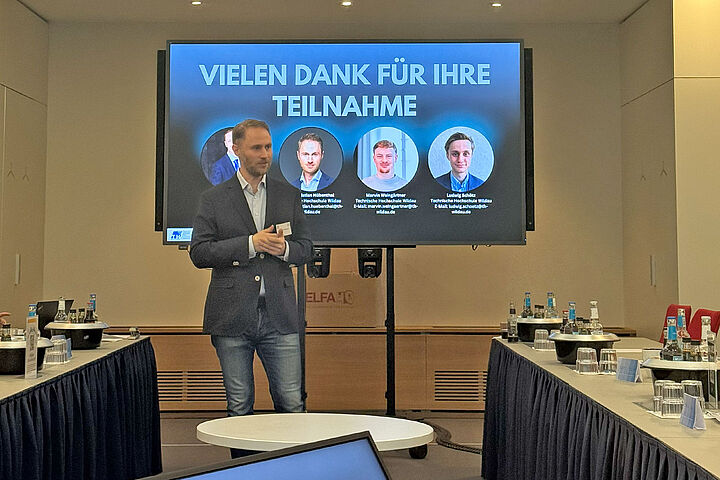
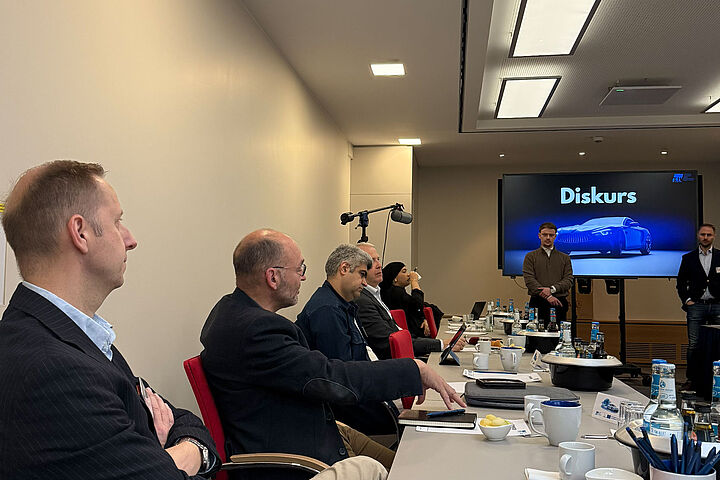
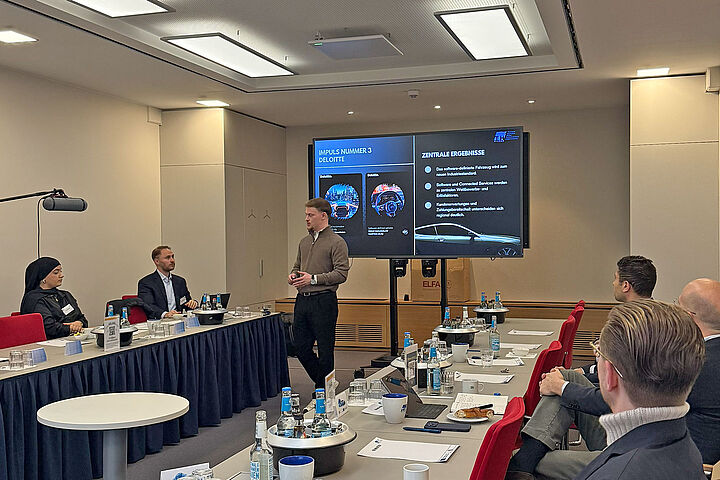
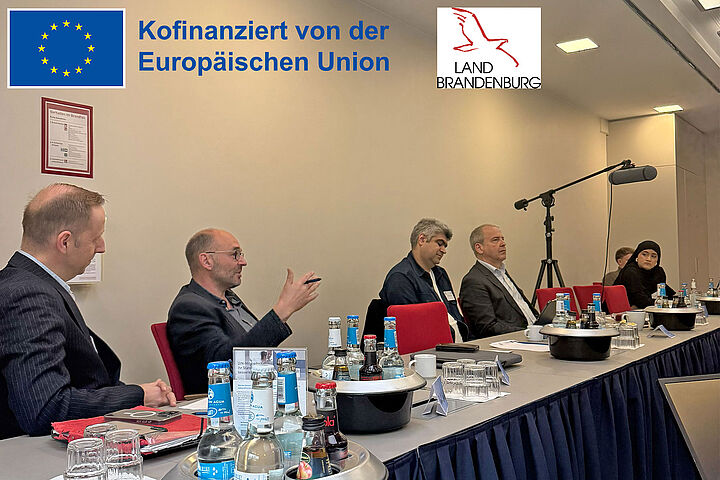
Der Tag startete in einer bewusst informellen Atmosphäre. Ein niedrigschwelliges Frühstücksformat mit Kaffee, Croissants und Brezeln bot den Teilnehmenden Raum für erste Gespräche und ein Kennenlernen abseits starrer Protokolle. Die Bilder der Veranstaltung fangen diese Arbeitsstimmung ein: Während an den Tischen angeregt diskutiert wird, lieferten Fachvorträge – etwa zu Ergebnissen von Deloitte – die nötigen Impulse für die anschließende Debatte.
Nach einer Begrüßung durch das DIN, das seine Rolle als Brückenbauer zwischen Standardisierung und Innovation skizzierte, rückten die drängenden Fragen der Branche in den Fokus.
Hardware vs. Software: Wo liegt der wahre Wettbewerbsvorteil?
Ein dominierendes Thema war der massive Wettbewerbsdruck durch asiatische Produzenten, insbesondere aus China. Die zentrale Frage war: Wie können sich deutsche Hersteller hier langfristig behaupten? Während der aktuelle Markttrend stark zum „software-defined car“ und zur Integration von KI neigt, wurde im Diskursraum eine differenziertere Sichtweise deutlich. Technologische Innovation ist nach Ansicht der Experten langfristig nur dann erfolgreich, wenn Softwarelösungen sinnvoll mit der physischen Fahrzeugarchitektur verzahnt werden.
„Der Wettbewerb wird nicht allein im Code entschieden. Mit der Automotive Research Platform Wildau entwickeln wir eine interdisziplinäre Forschungsplattform, die verdeutlicht, dass erst das Zusammenspiel von exzellenter Hardware und intelligenter Software echte Marktvorteile generiert“, betont Prof. Christian Schultz, der das Projekt an der TH Wildau verantwortet. „Die Einführung innovativer Hardwarekomponenten, wie unser neuartiges Fahrwerk, kann hier den entscheidenden Unterschied machen“.
ARP-Wi: Ein Prototyp für den Wissentransfer
Das Projekt ARP-Wi geht dabei weit über theoretische Diskussionen hinaus. Im Kern steht die Entwicklung eines Prototypenfahrzeugs mit einem neuartigen, patentierten allradgelenkten Neigefahrwerk. Dieses Fahrzeug dient als fächerübergreifende Plattform für Forschung und Transfer.
Hierbei greift die TH Wildau auf ihre bestehende Infrastruktur zurück:
-
Das Mobility Lab und die digitale Lernfabrik Wildauer Maschinen Werke (WMW) sind direkt in den Entwicklungsprozess eingebunden.
-
Innovationsräume wie das ViNN:Lab und das Opp:Lab fördern den kreativen Austausch.
-
Ingenieurwissenschaftliche Aspekte werden systematisch mit sozialwissenschaftlicher Forschung verknüpft.
„Durch die enge Einbindung unserer Labore verzahnen wir das Ingenieurwesen strukturell mit der Innovationsforschung“, so Prof. Schultz weiter. „Unser Ziel ist es, das hochschulweite Innovations- und Transferpotential in der Mobilität und Logistik massiv zu steigern und Know-how zu generieren, das direkt in neue Businessmodelle fließt.“
Ausblick: Der Diskurs geht weiter
Die Diskussionen am DIN zeigten, dass neben digitalen Innovationen die physischen Komponenten weiterhin eine Schlüsselrolle spielen. Für das Projekt ARP-Wi bot die Veranstaltung eine wertvolle Basis, um Trends frühzeitig zu reflektieren und in die eigene Forschung zu integrieren.
Wer den Dialog vertiefen möchte, muss nicht lange warten: Bereits für September 2026 ist der nächste Diskursraum geplant. Dann soll das Verhältnis von Hardware und Software in der zukünftigen Mobilität noch spezifischer unter die Lupe genommen werden.
Das Projekt ARP-Wi wird durch das Ministerium für Wissenschaft, Forschung und Kultur (MWFK) aus Mitteln des Europäischen Fonds für regionale Entwicklung (EFRE) gefördert.
“Germany under Pressure” – TH Wildau discusses the future of automotive industryBereich öffnenBereich schließen
How is the German automotive industry faring in the face of global competition? This question was at the heart of an in-depth exchange between academia and industry. As part of the Automotive Research Platform Wildau (ARP-Wi) project, TH Wildau hosted a special forum in Berlin.
On 26 March 2026, the German Institute for Standardisation (DIN) in Berlin was transformed into a forum for the mobility of tomorrow. Under the title “Germany under Pressure – What determines technological competition in the automotive sector?”, representatives from academia, start-ups and established companies came together to critically examine the direction the industry is taking.
Dialogue on equal terms: breakfast, inspiration and networking
The day began in a deliberately informal atmosphere. A low-key breakfast setting with coffee, croissants and pretzels gave participants space for initial conversations and getting to know one another away from rigid protocols. The photos from the event capture this working atmosphere: whilst lively discussions took place at the tables, papers – such as those on Deloitte’s findings – provided the necessary impetus for the ensuing debate.
Following a welcome address by DIN, which outlined its role as a bridge-builder between standardisation and innovation, the focus shifted to the pressing issues facing the industry.
Hardware vs. Software: Where does the real competitive advantage lie?
A dominant theme was the massive competitive pressure from Asian manufacturers, particularly from China. The central question was: How can German manufacturers hold their own here in the long term? Whilst the current market trend leans heavily towards the “software-defined car” and the integration of AI, a more nuanced perspective emerged in the discussion. According to the experts, technological innovation will only be successful in the long term if software solutions are meaningfully integrated with the physical vehicle architecture.
“Competition is not decided by code alone. With the Automotive Research Platform Wildau, we are developing an interdisciplinary research platform that demonstrates that it is the interplay of excellent hardware and intelligent software that generates real market advantages,” emphasises Prof. Christian Schultz, who is in charge of the project at TH Wildau. “The introduction of innovative hardware components, such as our novel chassis, can make the decisive difference here.”
ARP-Wi: A prototype for knowledge transfer
The ARP-Wi project goes far beyond theoretical discussions. At its core is the development of a prototype vehicle featuring a novel, patented all-wheel-steered tilting chassis. This vehicle serves as an interdisciplinary platform for research and transfer.
In doing so, TH Wildau draws on its existing infrastructure:
- The Mobility Lab and the Wildauer Maschinen Werke (WMW) digital learning factory are directly integrated into the development process.
- Innovation spaces such as the ViNN:Lab and the Opp:Lab foster creative exchange.
- Engineering aspects are systematically linked with social science research.
“By closely integrating our laboratories, we are structurally interlinking engineering with innovation research,” Prof. Schultze continued. “Our aim is to massively increase the university-wide potential for innovation and knowledge transfer in mobility and Logistics, and to generate expertise that flows directly into new business models.”
Outlook: The discourse continues
The discussions at DIN showed that, alongside digital innovations, physical components continue to play a key role. For the ARP-Wi project, the event provided a valuable basis for reflecting on trends at an early stage and integrating them into its own research.
Those wishing to deepen the dialogue need not wait long: the next ‘Discourse Space’ is already planned for September 2026. Then, the relationship between hardware and software in future mobility will be examined in even greater detail.
The ARP-Wi project is funded by the Ministry of Science, Research and Culture (MWFK) with funds from the European Regional Development Fund (ERDF).
Fachliche Ansprechperson
Prof. Dr. rer. pol. Christian Schultz
Fachbereich Wirtschaft, Informatik, Recht
Tel.: +49 3375 508 792
Mail: christian.schultz@th-wildau.de
Redaktionelle Ansprechperson

Sebastian Stoye
Zentrum für Hochschulkommunikation
Interne Kommunikation & Referent der Präsidentin
Tel.: +49 3375 508 340
Mobil-Tel.: +49 15679 158557
Mail: sebastian.stoye@th-wildau.de
Web: https://www.th-wildau.de/interne-kommunikation/
Haus 21, Raum A102
Präsidium: https://www.th-wildau.de/hochschule/praesidium