
Verbunden durch KI als Brückenbauerin für internationale Kooperationen: Wildau und Shanghai
Die TH Wildau festigt ihre globale Positionierung: Nach einer erfolgreichen Konferenz in Wildau Mitte Oktober reiste Prof. Jörg Reiff-Stephan im November nach Shanghai, um vor 400 Gästen zu sprechen und die Weichen für die Zukunft zu stellen. +++ English version below +++
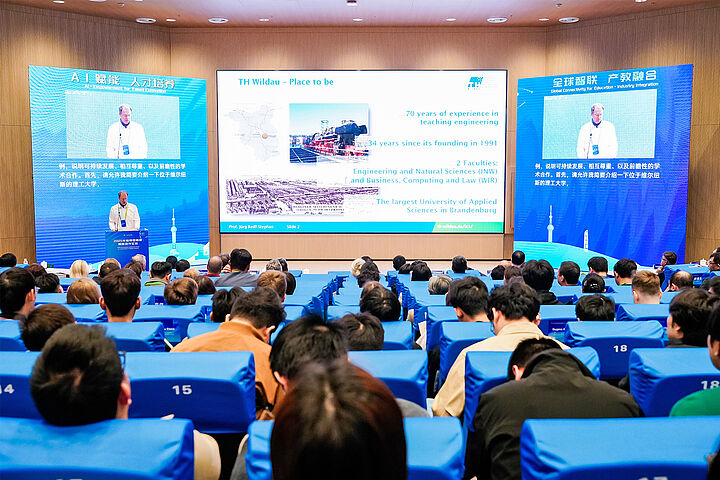
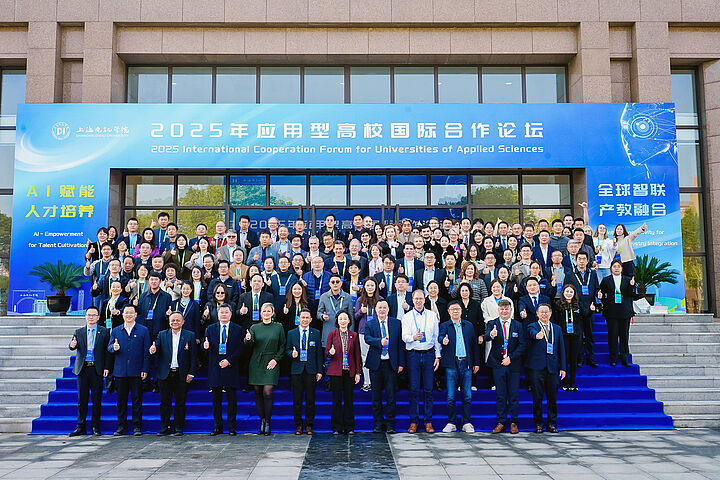
Künstliche Intelligenz (KI) ist längst mehr als nur eine Technologie – sie ist eine globale Sprache, die Wissenschaft und Wirtschaft über Kontinente hinweg verbindet. Dies bewies eindrucksvoll der jüngste Besuch von Prof. Jörg Reiff-Stephan an der Shanghai Dianji University (SDJU) vom 20. bis 24. November 2025. Als Keynote-Speaker auf dem „International Cooperation Forum for Universities of Applied Sciences“ vertrat er die TH Wildau vor rund 400 geladenen Gästen.
„Intelligente, innovative und praktische technologische Fortschritte in der künstlichen Intelligenz können einen wesentlichen Beitrag zur Bewältigung drängender Probleme unserer Zeit leisten“, betont Prof. Reiff-Stephan die Relevanz des Themas. Genau dieser Ansatz prägte seine Reise.
Ein starker Partner: Die Shanghai Dianji University
Die intensive Zusammenarbeit findet mit einem hochkarätigen Partner statt. Die Shanghai Dianji University (SDJU) ist eine moderne und zukunftsorientierte technische Universität in Shanghai, die sich durch einen starken Praxisbezug und eine ausgeprägte Verbindung von Lehre und Industrie auszeichnet. Mit rund 13.000 Studierenden und über 1.000 Lehrenden bietet sie eine solide akademische Basis.
Die Hochschule verfügt über zwei weitläufige Campus – im südlichen Industrie- und Technologiezentrum Lingang sowie im Minhang-Bezirk zentrumsnah der Metropole. Sie bietet ein breites Spektrum an Studienrichtungen: Vor allem Automatisierung, Maschinenbau, Materialwissenschaften, Elektrotechnik und Elektronik, aber auch Wirtschaft, Management und Geisteswissenschaften. Besonders hervorzuheben ist das internationale Profil der SDJU, die spezielle Austauschprogramme anbietet – etwa über ein deutsch-chinesisches Kolleg für intelligente Produktion (KKIP).
Weichenstellung in China: Der Blick nach vorn
Im Zentrum der Reise stand der Austausch zur Zukunft der Lehre und Forschung. Unter dem Titel „International Cooperation in the Era of AI“ sprach Prof. Reiff-Stephan am 23. November über die Notwendigkeit grenzüberschreitender Zusammenarbeit.
Die Ergebnisse der Reise sind für Studierende und Forschende der TH Wildau vielversprechend. In Abstimmungen mit SDJU-Vizepräsident Prof. Hongzhi Wang und Dekan Prof. Cheng Cai wurde ein konkreter Fahrplan erarbeitet:
- Summer School 2026: Mitte Juli 2026 können Studierende für zwei Wochen nach Shanghai reisen – zu äußerst attraktiven Konditionen vor Ort.
- Konferenz 2026: Die nächste Deutsch-Chinesische Konferenz wird Ende Oktober 2026 in Shanghai stattfinden.
- Doppelabschluss: Die Entwicklung eines Double-Degree-Studiengangs im Berufsbild Automatisierungstechniker*in wird vorangeschrieben.
Ein wachsendes Netzwerk
Die internationale Ausrichtung der TH Wildau beschränkt sich dabei nicht allein auf die SDJU. Die Hochschule baut ihre Präsenz in China konsequent aus: Über das Deutsche Hochschulkonsortium für Internationale Kooperationen (DHIK) wird aktuell eine Zusammenarbeit mit der renommierten Tongji-Universität angebahnt.
Neben Prof. Reiff-Stephan engagieren sich auch weitere Hochschulangehörige wie Prof. Christian Liebchen und Dr. Christine Avenarius aktiv für den Ausbau dieser Beziehungen, um Studierenden und Forschenden breite Perspektiven im globalen Umfeld zu eröffnen.
Rückblick: Weltpremiere in Wildau
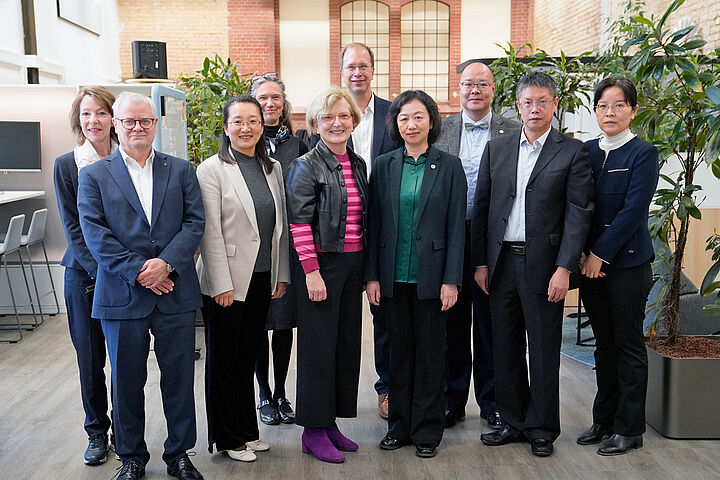
Der Erfolg in Shanghai baute direkt auf einem Meilenstein auf, der kurz zuvor in Wildau gesetzt wurde. Am 17. Oktober 2025 fand auf dem Campus der TH Wildau die „1. Sino-German Conference on Human-Centered AI“ statt.
Unter dem Leitbild einer „menschzentrierten KI“ diskutierten 65 Teilnehmende aus Politik, Wissenschaft und Wirtschaft, wie technologische Innovation mit ethischer Verantwortung vereint werden kann. Prof. Reiff-Stephan fasst die Motivation für diese Zusammenarbeit so zusammen: „Die chinesisch-deutsche Konferenz fördert den Dialog und die Zusammenarbeit, um die Entwicklung und Anwendung von Künstlicher Intelligenz mit einem klaren Fokus auf den Menschen voranzutreiben.“
Highlights der Konferenz in Wildau:
- Starke Vernetzung: 12 Speaker und 6 Aussteller (u.a. GFaI, IMK Industrial Intelligence) präsentierten innovative Lösungen.
- Praxisnahe Einblicke: Laborführungen, etwa durch das KILEAN-Labor, demonstrierten die praktische Stärke der TH Wildau.
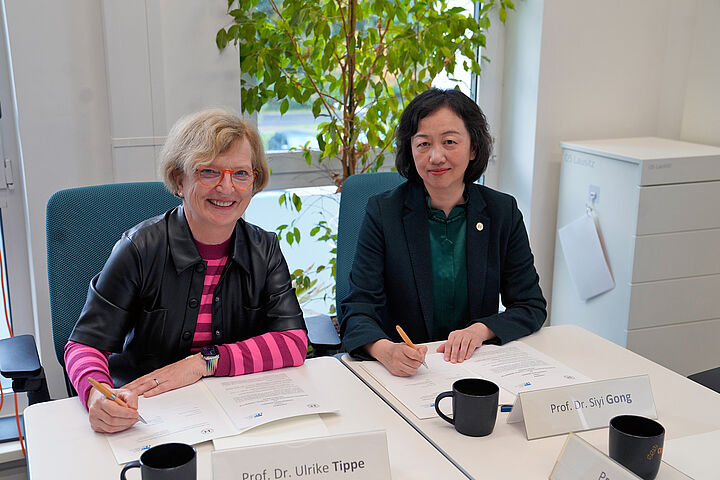
- Vertragsschluss: Ein neuer Kooperationsvertrag besiegelte die langfristige Partnerschaft, vor allem für den Studierendenaustausch.
„Unser Ziel ist es, Wissen zu teilen, Best Practices zu entwickeln und innovative Lösungen zu schaffen, die die Gesellschaft im digitalen Zeitalter positiv beeinflussen“, erklärt Reiff-Stephan die Freude über den gelungenen Austausch.
Connected by AI as a bridge builder for international cooperationBereich öffnenBereich schließen
TH Wildau consolidates its global positioning: Following a successful conference in Wildau in mid-October, Prof. Jörg Reiff-Stephan traveled to Shanghai in November to speak to 400 guests and set the course for the future.
Artificial intelligence (AI) has long been more than just a technology – it is a global language that connects science and business across continents. This was impressively demonstrated by Prof. Jörg Reiff-Stephan's recent visit to Shanghai Dianji University (SDJU) from November 20 to 24, 2025. As keynote speaker at the “International Cooperation Forum for Universities of Applied Sciences,” he represented TH Wildau in front of around 400 invited guests.
“Intelligent, innovative, and practical technological advances in artificial intelligence can make a significant contribution to solving the pressing problems of our time,” says Prof. Reiff-Stephan, emphasizing the relevance of the topic. It was precisely this approach that shaped his trip.
A strong partner: Shanghai Dianji University
The intensive collaboration is taking place with a high-caliber partner. Shanghai Dianji University (SDJU) is a modern and future-oriented technical university in Shanghai that is characterized by a strong practical focus and a distinctive connection between teaching and industry. With around 13,000 students and over 1,000 teaching staff, it offers a solid academic foundation.
The university has two spacious campuses – in the southern industrial and technology center of Lingang and in the Minhang district close to the center of the metropolis. It offers a wide range of fields of study, primarily in automation, Mechanical Engineering, materials science, electrical engineering, and electronics, but also in economics, management, and the humanities. Particularly noteworthy is the international profile of SDJU, which offers special exchange programs, such as a German-Chinese college for intelligent production (KKIP).
Setting the course in China: Looking ahead
The focus of the trip was on exchanging ideas about the future of teaching and research. Under the title “International Cooperation in the Era of AI,” Prof. Reiff-Stephan spoke on November 23 about the need for cross-border cooperation.
The results of the trip are promising for students and researchers at TH Wildau. In consultation with SDJU Vice-president Prof. Hongzhi Wang and Dean Prof. Cheng Cai, a concrete roadmap was developed:
- Summer School 2026: In mid-July 2026, students will be able to travel to Shanghai for two weeks – at extremely attractive local conditions.
- Conference 2026: The next German-Chinese conference will take place in Shanghai at the end of October 2026.
- Double degree: The development of a double degree programme in Automation Technology is being promoted.
A growing network
The international orientation of TH Wildau is not limited to SDJU alone. The university is consistently expanding its presence in China: Through the German University Consortium for International Cooperation (DHIK), a collaboration with the renowned Tongji University is currently being initiated.
In addition to Prof. Reiff-Stephan, other university members such as Prof. Christian Liebchen and Dr. Christine Avenarius are also actively involved in expanding these relationships in order to open up broad perspectives for students and researchers in a global environment.
Review: World premiere in Wildau
The success in Shanghai built directly on a milestone that had been set shortly before in Wildau. On October 17, 2025, the “1st Sino-German Conference on Human-Centered AI” took place on the campus of TH Wildau.
Under the mission of “human-centered AI,” 65 participants from politics, science, and business discussed how technological innovation can be combined with ethical responsibility. Prof. Reiff-Stephan summarizes the motivation for this collaboration as follows: “The Sino-German conference promotes dialogue and cooperation to advance the development and application of artificial intelligence with a clear focus on people.”
Highlights of the conference in Wildau:
- Strong networking: 12 speakers and 6 exhibitors (including GFaI, IMK Industrial Intelligence) presented innovative solutions.
- Practical insights: Laboratory tours, such as through the KILEAN laboratory, demonstrated the practical strengths of TH Wildau.
- Conclusion of agreement: A new cooperation agreement sealed the long-term partnership, especially for student exchanges.
“Our goal is to share knowledge, develop best practices, and create innovative solutions that positively influence society in the digital age,” said Reiff-Stephan, expressing his delight at the successful exchange.
Fachliche Ansprechpersonen

Prof. Dr.-Ing. Jörg Reiff-Stephan
Fachbereich Ingenieur- und Naturwissenschaften
Tel.: +49 3375 508 418
Mail: joerg.reiff-stephan@th-wildau.de
Haus 24, Raum 211
Forschungsgruppe "iC3@Smart Production"
http://www.th-wildau.de/ic3/

Karin Schmidt
Zentrum für internationale Angelegenheiten
Leitung International Office
Tel.: +49 3375 508 851
Mail: karin.schmidt@th-wildau.de
Web: https://www.th-wildau.de/personen/karin-schmidt/
Haus 13, Raum 035
Sprechstunden: täglich zwischen 10 und 16 Uhr
Neben Präsenzsprechstunden bieten wir auch Beratungen via WebEx an:
th-wildau.webex.com/meet/karin.schmidt
Andere Termine sind nach Absprache möglich
Consultation hours: each day between 10 AM and 4 PM
In addition to face-to-face consultaionts, we also offer consultations via WebEx:
th-wildau.webex.com/meet/karin.schmidt
Other appointments are possible by prior appointment.
Redaktionelle Ansprechperson

Sebastian Stoye
Zentrum für Hochschulkommunikation
Interne Kommunikation & Referent der Präsidentin
Tel.: +49 3375 508 340
Mobil-Tel.: +49 15679 158557
Mail: sebastian.stoye@th-wildau.de
Web: https://www.th-wildau.de/interne-kommunikation/
Haus 21, Raum A102
Präsidium: https://www.th-wildau.de/hochschule/praesidium