
TH Wildau eröffnet das neue XR:Lab als Innovationsraum für die Lehre
Ein neuer Hotspot für zukunftsweisende Technologien hat auf dem Campus unserer Hochschule seine Türen geöffnet: Am Mittwoch, den 1. Juli, wurde das XR:Lab in Raum A112 in der LOK21 feierlich eingeweiht. Von 13 bis 17 Uhr strömten neugierige Studierende, Lehrende und Forschende in den lichtdurchfluteten Raum, um in die Welt der Augmented, Mixed und Virtual Reality einzutauchen – ganz ohne Berührungsängste und im direkten, interdisziplinären Austausch. +++ English version below +++
Brillen auf, Hände hoch: Einblick in die Eröffnung
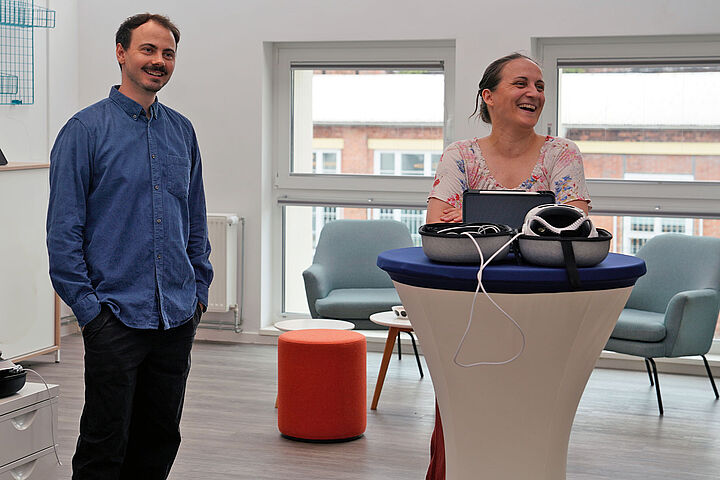
Schon beim Betreten des neuen Labs wurde klar: Hier trifft modernste Technik auf eine einladende, kreative Arbeitsatmosphäre. Während an den Wänden moderne PC-Arbeitsplätze auf ihren Einsatz warteten, standen im Zentrum des Raumes gemütliche Sitzecken und Stehtische im Fokus des Geschehens.
Besonders eine Station zog die Blicke auf sich: Auf den Stehtischen warteten die weißen Boxen der Apple Vision Pro. Wer die Brille aufsetzte, wurde direkt per iPad-Übertragung vom System begrüßt: „Hold your hands up and look at them“, eine kurze Hand-Kalibrierung, und schon schwebten die bunten App-Icons mitten im Raum.
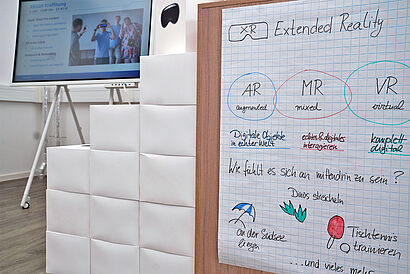
Für den theoretischen, aber spielerischen Einstieg sorgte ein liebevoll gestaltetes Whiteboard direkt neben dem Eingang: Mit bunten Skizzen wurde hier der Unterschied zwischen AR (digitale Objekte in der echten Welt), MR (Interaktion zwischen Realität und Digitalem) und VR (komplett digital) erklärt. Versehen mit humorvollen Beispielen wie „Dinos streicheln“, „an der Südsee liegen“ oder „Tischtennis trainieren“, verloren selbst XR-Neulinge sofort die Scheu vor der neuen Technik.
Didaktik statt reiner Spielerei: XR in der Lehre
Das XR:Lab versteht sich explizit nicht als reine Tech-Spielwiese, sondern als strategischer Partner für die Lehrenden der TH Wildau. Ziel ist es, immersive Technologien gezielt in Curricula, Vorlesungen und Module einzubinden, um einen echten didaktischen Mehrwert zu schaffen.
Ob es um die realitätsnahe Simulation komplexer Entscheidungssituationen geht oder um die visuelle Darstellung dreidimensionaler Modelle – das Team des XR:Labs unterstützt Lehrende von der ersten Idee bis zur technischen Umsetzung.
Vorbeikommen und Ausprobieren: So geht es weiter
Das XR:Lab setzt auf ein barrierefreies „Komm einfach vorbei“-Konzept, angelehnt an die erfolgreichen Open Lab Days des ViNN:Labs und Opp:Labs. Ein wöchentlicher offener Tag (voraussichtlich Dienstag) sowie feste Sprechstunden befinden sich aktuell in der finalen Abstimmung und werden zeitnah bekanntgegeben.
Wer nicht so lange warten möchte oder bereits eine konkrete Projektidee im Kopf hat, kann sich jederzeit direkt an das Team wenden. Der Austausch wird zudem über eine gemeinsame Webex-Gruppe und semesterweise Netzwerktreffen lebendig gehalten.
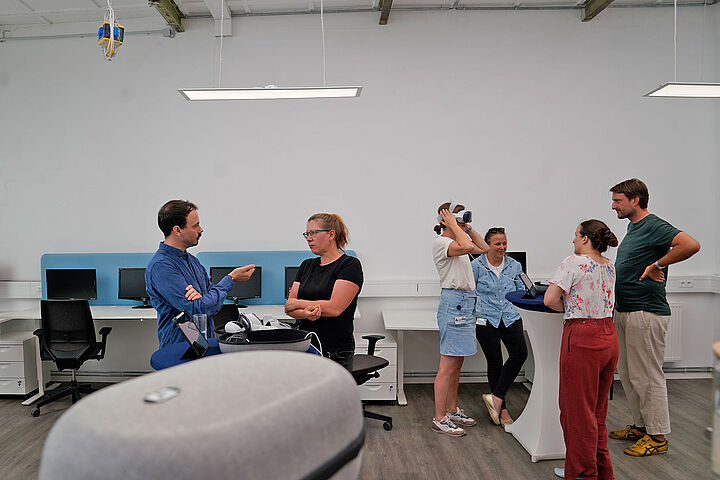
Im Gespräch mit dem XR:Lab-Team Susann Schulz und Luca FröslerBereich öffnenBereich schließen
Für die inhaltliche und didaktische Begleitung stehen ab sofort zwei feste Ansprechpersonen zur Verfügung: Luca Frösler (Schwerpunkt Ausleihe und Technik) und Susann Schulz (Schwerpunkt Didaktik).
Im Interview erklären sie, wie der Einstieg ins Lab gelingt.
Wie läuft die Unterstützung für Lehrende im Alltag ab?
Susann Schulz: Das Lab ist gerade erst eröffnet, und wir möchten den Unterstützungsprozess ganz bewusst gemeinsam mit den Lehrenden gestalten. Wichtig ist vor allem die Frage nach dem Ziel: Geht es darum, den Studierenden zu zeigen, was technisch möglich ist? Entwickeln sie eigene Anwendungen? Oder dient XR als immersive Simulation, um eine Situation realitätsnah nachzubauen und zu erproben, bevor real etwas umgesetzt wird? Von da aus überlegen wir gemeinsam, was zum jeweiligen Modul passt. So lassen sich traditionelle Lehrformate nachhaltig aufwerten – nicht um der Technik willen, sondern dort, wo XR einen didaktischen Mehrwert bietet.
Wo seht ihr die spannendsten Synergien zwischen KI und XR an unserer Hochschule?
Luca Frösler: Synergien sehen wir vor allem an drei Stellen. Erstens senkt KI die Einstiegshürde in die 3D-Erstellung enorm, zum Beispiel vom Foto oder einem kurzen Text direkt zum fertigen 3D-Modell. Zweitens hilft sie dabei, das Programmieren immersiver Welten zu verstehen, bis hin zum „Vibe Coding“, bei dem eine Anwendung weitgehend im Dialog mit einer KI entsteht. Und drittens liegt das XR:Lab Tür an Tür mit dem Robotik-Labor, das ebenfalls stark mit KI arbeitet; daraus sind gemeinsame Vorhaben denkbar, etwa eine Robotersteuerung per Vision Pro mit Sprache und Gesten.
Wie helft ihr Studierenden ohne Coding-Erfahrung beim ersten Schritt?
Luca Frösler: Wer eine Idee mitbringt, kennt die Brille meistens schon. Wir überlegen dann gemeinsam, wie sich die Idee konkret und technisch machbar umsetzen lässt. Zum eigenständigen Weiterprobieren stehen unsere Basis-Apps bereit, umgesetzt in Unity und Swift, deren Quellcodes im hochschulinternen GitLab liegen. Zudem bauen wir gerade einen Moodle-Kursraum mit Anleitungen auf.
Wer ohne Programmierkenntnisse bauen möchte, kann perspektivisch auf No-Code-Werkzeuge setzen.
Susann Schulz: Und wer tiefer einsteigen will, findet im kommenden Semester im Interdisziplinären Modul (IDM) den passenden Rahmen: prototypische App-Entwicklung in interdisziplinären Teams entlang des Design-Thinking-Ansatzes, inklusive eines Vibe-Coding-Workshops.
Vorbeikommen und ausprobieren: So geht es weiter
Das XR:Lab setzt auf ein barrierefreies „Komm einfach vorbei“-Konzept, angelehnt an die erfolgreichen Open Lab Days des ViNN:Labs und Opp:Labs. Ein wöchentlicher offener Tag (voraussichtlich Dienstag) sowie feste Sprechstunden befinden sich aktuell in der finalen Abstimmung und werden zeitnah bekanntgegeben.
Wer nicht so lange warten möchte oder bereits eine konkrete Projektidee im Kopf hat, kann sich jederzeit direkt an das Team wenden. Der Austausch wird zudem über eine gemeinsame Webex-Gruppe und semesterweise Netzwerktreffen lebendig gehalten.
English: TH Wildau opens the new XR:Lab as an innovation space for teachingBereich öffnenBereich schließen
Virtual worlds you can experience first-hand: TH Wildau opens the new XR:Lab as an innovation space for teaching
A new hub for cutting-edge technologies has opened its doors on the campus of our university: on Wednesday 1 July, the XR:Lab in room A112 in LOK21 was officially inaugurated. From 1 pm to 5 pm, curious students, teachers and researchers flocked to the light-filled room to immerse themselves in the world of augmented, mixed and virtual reality – without any reservations and through direct, interdisciplinary exchange.
Glasses on, hands up: a glimpse into the opening
As soon as you stepped into the new lab, it was clear: this is where cutting-edge engineering meets a welcoming, creative working atmosphere. Whilst modern PC workstations lined the walls, ready for use, cosy seating areas and bar tables in the centre of the room took centre stage.
One station in particular caught everyone’s eye: the white Apple Vision Pro boxes were waiting on the bar tables. Anyone who put on the glasses was immediately greeted by the system via an iPad feed: “Hold your hands up and look at them”, a quick hand calibration, and before you knew it, the colourful app icons were floating in the middle of the room.
A lovingly designed whiteboard right next to the entrance provided a theoretical yet playful introduction: colourful sketches were used here to explain the difference between AR (digital objects in the real world), MR (interaction between reality and the digital world) and VR (completely digital). Featuring humorous examples such as “petting dinosaurs”, “lounging by the South Seas” or “practising table tennis”, even XR novices immediately lost their shyness about the new technology.
Education rather than mere gimmicks: XR in teaching
The XR:Lab explicitly sees itself not as a mere tech playground, but as a strategic partner for teachers at TH Wildau. The aim is to integrate immersive technologies specifically into curricula, lectures and modules in order to create genuine educational added value.
Whether it involves realistic simulations of complex decision-making scenarios or the visual representation of three-dimensional models – the XR:Lab team supports teachers from the initial idea right through to technical implementation.
Drop by and have a go: What’s next
The XR:Lab is based on an accessible ‘just drop by’ concept, modelled on the successful Open Lab Days of the ViNN:Lab and Opp:Lab. A weekly open day (provisionally on Tuesdays) and fixed consultation hours are currently being finalised and will be announced shortly.
Anyone who doesn’t want to wait that long, or who already has a specific project idea in mind, can contact the team directly at any time. Discussions are also kept alive via a shared Webex group and termly networking meetings.
In conversation with the XR:Lab team: Susann Schulz and Luca Frösler
Two permanent contact persons are now available to provide support with content and teaching methods: Luca Frösler (with a track record in lending and engineering) and Susann Schulz (with a track record in teaching methods).
In this interview, they explain how to get started at the Lab.
How does the support for teachers work in day-to-day practice?
Susann Schulz: The Lab has only just opened, and we want to deliberately shape the support process together with the teachers. The most important question is what the aim is: is it about showing students what is technically possible? Are they developing their own applications? Or does XR serve as an immersive simulation to recreate and test a situation realistically before it is implemented in reality? From there, we work together to consider what suits the respective module. In this way, traditional teaching formats can be enhanced in the long term – not for the sake of engineering, but where XR offers added educational value.
Where do you see the most exciting synergies between AI and XR at our university?
Luca Frösler: We see synergies primarily in three areas. Firstly, AI drastically lowers the barrier to entry for 3D creation – for example, going directly from a photo or a short text to a finished 3D model. Secondly, it helps students understand how to programme immersive worlds, right through to ‘vibe coding’, where an application is created largely through dialogue with an AI. And thirdly, the XR:Lab is right next door to the robotics laboratory, which also makes extensive use of AI; this opens up possibilities for joint projects, such as controlling a robot via Vision Pro using voice and gestures.
How do you help students with no coding experience take their first steps?
Luca Frösler: Anyone who comes up with an idea is usually already familiar with the headset. We then work together to consider how the idea can be implemented in a concrete and technically feasible way. Our basic apps, built in Unity and Swift, are available for students to experiment with independently; their source codes are hosted on the university’s internal GitLab. We’re also currently setting up a Moodle course room with tutorials.
Anyone who wants to build something without any programming knowledge can, in the future, make use of no-code tools.
Susann Schulz: And for those who want to delve deeper, the Interdisciplinary Module (IDM) in the coming semester offers the ideal framework: prototypical app development in interdisciplinary teams using the design thinking approach, including a vibe-coding workshop.
Drop by and give it a go: What’s next
The XR:Lab is based on an accessible ‘just drop by’ concept, modelled on the successful Open Lab Days organised by ViNN:Lab and Opp:Lab. A weekly open day (provisionally on Tuesdays) and fixed consultation hours are currently being finalised and will be announced shortly.
Anyone who doesn’t want to wait that long, or who already has a specific project idea in mind, can contact the team directly at any time. Discussions are also kept alive via a shared Webex group and termly networking meetings.
Fachliche Ansprechperson

Susann Schulz
Zentrum für Studium und Lehre
Tel.: +49 3375 508 927
Mobil-Tel.: +49 151 22037489
Mail: susann.schulz@th-wildau.de
Web: http://www.th-wildau.de/sel2
Haus 21, Raum A104
Bereich „Service Lernen und Lehren“ [SeL²] im Zentrum für Studium und Lehre (ZSL) – Hochschuldidaktik

Bachelor of Science Luca Frösler
Zentrum für Studium und Lehre
XR-Entwickler
Mail: luca.froesler@th-wildau.de
Haus 21, Raum A104
Redaktionelle Ansprechperson

Sebastian Stoye
Zentrum für Hochschulkommunikation
Interne Kommunikation & Referent der Präsidentin
Tel.: +49 3375 508 340
Mobil-Tel.: +49 15679 158557
Mail: sebastian.stoye@th-wildau.de
Web: https://www.th-wildau.de/interne-kommunikation/
Haus 21, Raum A102
Präsidium: https://www.th-wildau.de/hochschule/praesidium