
Zukunft gestalten durch Forschung und Transfer: Drei neue Schwerpunktprofessuren an der TH Wildau feierlich vergeben
Von zukunftsweisenden Quantenmaterialien über eine bürgernahe, digitale Verwaltung bis hin zu praxistauglicher Künstlicher Intelligenz für den Mittelstand: Am 3. September 2026 wurden an der TH Wildau im festlichen Rahmen drei neue Forschungs- und Transferprofessuren verliehen. Prof. Carolin Schmitz-Antoniak, Prof. Isabell Peters und Prof. Jörg Reiff-Stephan gestalten in den kommenden fünf Jahren zentrale Zukunftsthemen für die Hochschule und die Region. +++ Englisch version below: Shaping the future through research and knowledge transfer: Three new priority professorships awarded at TH Wildau in a ceremonial event +++
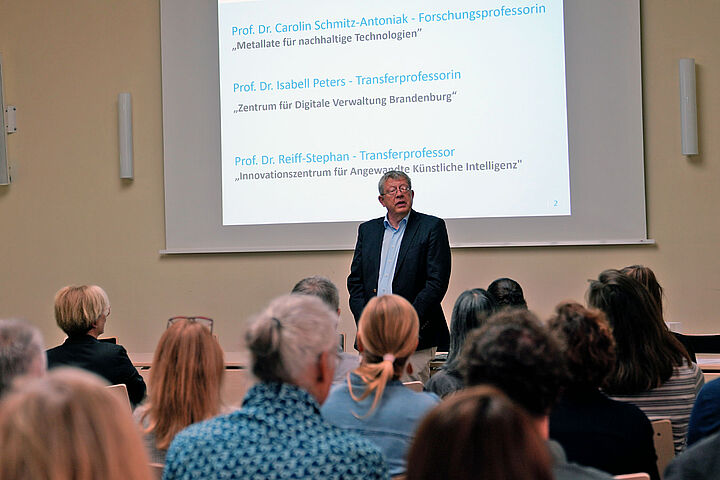
Der vollbesetzte Hofsaal auf dem Wildauer Campus bot am Vormittag des 3. September 2026 die passende Kulisse für eine Weichenstellung mit Signalwirkung: Zwischen 10:00 und 12:00 Uhr fand die feierliche Ernennung und Vorstellung der neuen Forschungs- und Transferprofessuren im hochschulöffentlichen Rahmen statt.
Eröffnet wurde die Veranstaltung von Prof. Klaus-Martin Melzer, Vizepräsident für Forschung und Transfer, der den Stellenwert dieses Förderinstruments hervorhob: „Die Forschungs- und Transferprofessuren sind eine der wesentlichen Instrumente, die wir haben, um Forschung und Transfer an unserer Hochschule nachhaltig voranzubringen. Sie haben sich über viele Jahre hinweg bewährt. Durch die heutigen Vergaben erzeugen wir weitere entscheidende Hebel und eine neue Dynamik in unseren regionalen wie überregionalen Aktivitäten.“
Wissenschaft im Kontinuum – von der Grundlagenforschung in die Gesellschaft
In ihrem anschließenden Grußwort ordnete Hochschulpräsidentin Prof. Ulrike Tippe die Professuren in die strategische Entwicklung der TH Wildau und der Hochschullandschaft ein. Grundlagenforschung, angewandte Forschung und Transfer seien längst keine voneinander getrennten Disziplinen mehr, sondern bildeten ein nahtloses Kontinuum: „Als Hochschule für Angewandte Wissenschaften bewegen wir uns häufig in diesem Kontinuum. Gerade als HAW tragen wir eine starke Verantwortung dafür, die Region und das gesamte Land Brandenburg mit Blick auf die immensen Herausforderungen voranzubringen.“
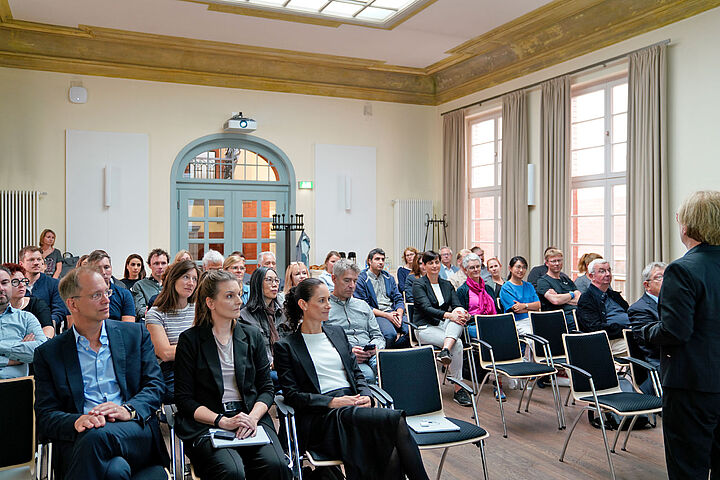
Zugleich richtete die Präsidentin einen klaren Appell an die Hochschulgemeinschaft: Angesichts wachsender Wissenschaftsskepsis sei es entscheidender denn je, Ergebnisse verständlich in die Gesellschaft zu tragen. „Wir müssen nicht nur auf politische Entwicklungen schauen, sondern schlichtweg spannende und interessante zukunftsweisende Dinge tun. Wenn wir unsere Arbeit begreifbar und erlebbar machen und aktiv darüber sprechen, kommt Wissenschaft in der Gesellschaft an.“
Im Anschluss vollzog Ulrike Tippe die formelle Bestellung der drei Professor*innen für die fünfjährige Laufzeit vom 1. September 2026 bis zum 31. August 2031: Prof. Carolin Schmitz-Antoniak wurde zur Professorin mit dem Schwerpunkt Forschung bestellt, während Prof. Isabell Peters und Prof. Jörg Reiff-Stephan jeweils eine Professur mit dem Schwerpunkt Transfer übertragen bekamen.
In kompakten, zehnminütigen Vorträgen stellten die drei Ausgezeichneten ihre Vorhaben für die kommenden fünf Jahre vor.
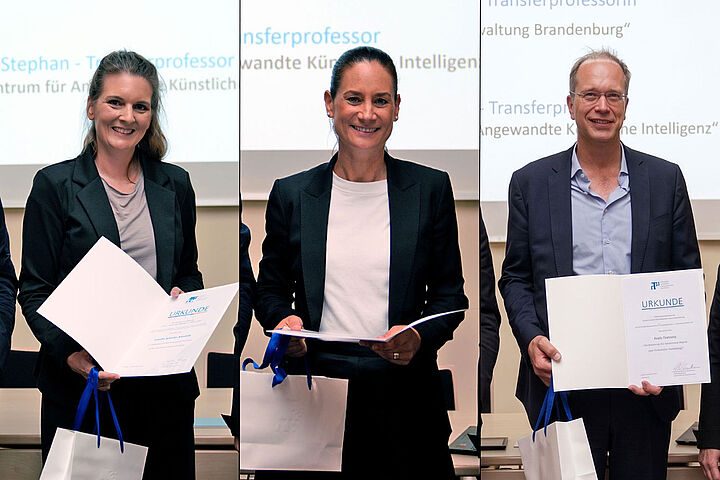
Prof. Dr. Carolin Schmitz-AntoniakBereich öffnenBereich schließen
Maßgeschneiderte Materialien für die Quanten- und Speichertechnik von morgen
Mit ihrer Forschungsprofessur widmet sich Prof. Carolin Schmitz-Antoniak dem Thema „Metallate für nachhaltige Technologien“.
Was verbirgt sich hinter dem Begriff „Metallate“? Vereinfacht formuliert handelt es sich um chemische Verbindungen, in deren Kern ein einzelnes Metallatom – etwa Eisen, Kupfer oder Cobalt – sitzt, umgeben von einem Netzwerk aus anderen Elementen wie Sauerstoff oder Schwefel. Durch diesen Aufbau lassen sich die physikalischen Eigenschaften der Moleküle wie mit einem Baukasten gezielt steuern.
Im Fokus ihrer Arbeit stehen zwei konkrete Materialgruppen:
Polyoxometallate (sauerstoffreiche Metallate): Diese können als winzige Lichtdetektoren dienen, die bereits auf einzelne Lichtteilchen (Photonen) reagieren. Das ist ein entscheidender Baustein für die Quantenkryptographie – also Verfahren, mit denen Daten absolut abhörsicher verschlüsselt werden können. Zudem erforscht das Team, ob sich diese Moleküle als Recheneinheiten (Qubits) für künftige Quantencomputer eignen.
Alkali-Sulfidometallate (schwefelbasierte Festkörper): Sie bieten großes Potenzial für neuartige, langlebige Batterien, die ohne teures und knappes Lithium auskommen. Darüber hinaus ermöglichen ihre magnetischen Eigenschaften die Entwicklung sogenannter magnetoresistiver Speicher (MRAM). Das sind extrem schnelle Computerspeicher, die ihre Daten auch beim Ausschalten des Geräts nicht verlieren.
Um die Prozesse im Inneren der Atome sichtbar zu machen, nutzt Schmitz-Antoniak unter anderem die hochintensive Röntgenstrahlung des Elektronenspeicherrings BESSY II am Helmholtz-Zentrum Berlin in Adlershof. Im Sinne der Nachhaltigkeit setzt das Vorhaben auf gut verfügbare Ausgangsstoffe, um auf seltene Erden verzichten zu können und den Energiebedarf zukünftiger Technologien radikal zu senken.
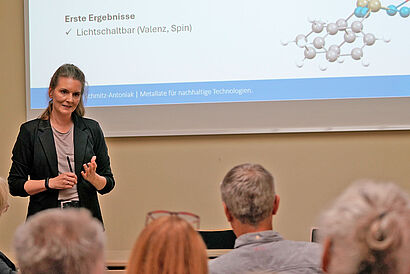
Prof. Dr. Isabell PetersBereich öffnenBereich schließen
Das Zentrum für Digitale Verwaltung Wildau (ZDV)
Prof. Isabell Peters rückt mit ihrer Transferprofessur eine der drängendsten Aufgaben unserer Zeit in den Mittelpunkt: die digitale Transformation der öffentlichen Verwaltung. Im Rahmen ihrer Professur baut sie das Zentrum für Digitale Verwaltung Wildau (ZDV) auf.
Echte digitale Transformation bedeutet weit mehr, als bestehende analoge Antragsformulare einfach in PDF-Dateien umzuwandeln. Vielmehr geht es darum, Verwaltungsprozesse von Grund auf neu zu denken. Vor allem kleinere Kommunen in Brandenburg stehen vor einem Dilemma: Mit oft nur wenigen Mitarbeitenden in den Rathäusern müssen sie das gleiche, rechtlich anspruchsvolle Leistungsspektrum bewältigen wie Großstädte – verfügen aber selten über eigene IT-Entwicklungsabteilungen oder hohe Beratungsbudgets.
Hier setzt das ZDV als Scharnier und Ökosystem zwischen Wissenschaft, kommunaler Verwaltung und GovTech-Unternehmen an:
- Praxisnahe Qualifizierung: Über Initiativen wie den European Digital Innovation Hub (pro_digital) bietet das Zentrum Weiterbildungen für Verwaltungsbeschäftigte zu Themen wie Datenmanagement, Prozessoptimierung und dem gezielten Einsatz von KI im Arbeitsalltag an.
- Innovationsmarktplatz: Bei regelmäßigen Formaten wie den DemoDays (in Kooperation mit dem Nationalen E-Government Kompetenzzentrum / NEGZ) erhalten Behörden Einblicke in moderne Softwarelösungen, etwa im Bereich No-Code/Low-Code.
- Verantwortungsvolle KI: In der Forschung untersucht Isabell Peters, wie KI-Implementierung in behörden gelingt. Gegenstand ist bspw., wie das Prinzip „Human in the Loop“ in der Praxis zu realisieren ist – also wie künstliche Intelligenz Sachbearbeiter*innen bei Entscheidungen wirksam entlastet, ohne dass die menschliche Verantwortung und Transparenz verloren gehen.
- Wissenstransfer für die Praxis: Mit den „Wildauer Papers on Digital Government“ und kompakten Policy Briefs stellt das ZDV wissenschaftlich fundierte Orientierungshilfen direkt für Entscheidungsträger*innen in Politik und Verwaltung bereit.
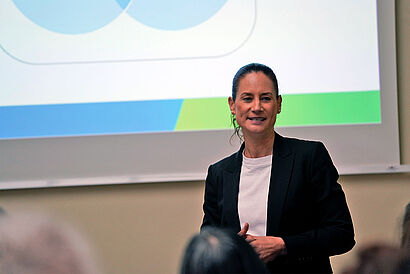
Prof. Dr.-Ing. Jörg Reiff-StephanBereich öffnenBereich schließen
KI-Innovationen für Brandenburgs Mittelstand greifbar machen
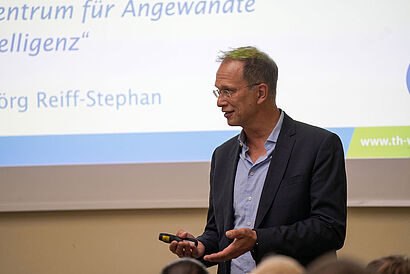
Mit dem Aufbau des „Innovationszentrums für Angewandte Künstliche Intelligenz“ verbindet Prof. Jörg Reiff-Stephan die langjährige technologische Expertise seines Instituts für Cyberphysische Produktionssysteme (iCPPS) mit den realen Anforderungen der regionalen Wirtschaft.
In Brandenburg gibt es über 90.000 kleine und mittlere Unternehmen (KMU) mit weniger als zehn Angestellten. Für diese Betriebe ist der Einstieg in moderne KI-Systeme oft eine kaum überwindbare Hürde, da es an Zeit, personellen Ressourcen und spezialisiertem Wissen fehlt. Das neue Innovationszentrum will genau diesen Raum bieten: Statt schwer verständlicher Theorie liefert es anwendungsbereite Werkzeuge, die Betriebe direkt ausprobieren und in ihren Alltag integrieren können.
Die Schwerpunkte der Professur umfassen:
- Praxislabore und mobile Demonstratoren: Anknüpfend an die Modellfabrik Wildauer Smart Production und Formate wie die Mobile Digitale Factory bringt das Team Technologie direkt vor Ort zu den Betrieben. Das Spektrum reicht von der vorausschauenden Wartung von Maschinen (Predictive Maintenance) bis hin zu automatisierten Büroabläufen und Sprachassistenten.
- Mensch-Roboter-Kollaboration und Inklusion: Im Sinne des Leitbilds Industrie 5.0 steht der Mensch im Mittelpunkt der Technologie. Mit Vorhaben wie NEXUS-OPEN erforscht das Team, wie sensorbasierte Robotik und KI-Assistenzsysteme Menschen mit körperlichen oder kognitiven Einschränkungen am Arbeitsplatz gezielt unterstützen können, um Teilhabe und Produktivität gleichermaßen zu stärken.
- Regionale und internationale Vernetzung: Als Nukleus dienen starke Netzwerke wie das Wildauer Netzwerk für Künstliche Intelligenz (WiN-KI) und das Wirtschaftsnetzwerk NET4AI. Die Aktivitäten reichen von regionalen Fachforen bis hin zu internationalen Partnerschaften, etwa dem Austausch mit Technologiezentren in Europa und Asien.
Lebendiger Diskurs als Auftakt für fünf erfolgreiche Jahre
Dass die Themen den Nerv der Zeit treffen, zeigte sich in der anschließenden, lebhaften Diskussionsrunde im Hofsaal. Diskutiert wurden unter anderem Fragen der digitalen Souveränität, der Umgang mit geopolitischen Risiken bei internationalen Technologiepartnerschaften sowie die Notwendigkeit, agile Reallabore für Verwaltung und Wirtschaft zu schaffen.
Vizepräsident Prof. Klaus-Martin Melzer fasste die Aufbruchstimmung zum Abschluss treffend zusammen: „Die Intensität und Tiefe der heutigen Diskussionen hat eindrucksvoll unter Beweis gestellt, dass wir genau an den richtigen Stellen anpacken. Die Vorhaben unserer Kolleg*innen besitzen eine immense Relevanz – für die wissenschaftliche Profilbildung unserer Hochschule, aber vor allem für die Menschen, Betriebe und Verwaltungen in Brandenburg. Ich gratuliere ihnen herzlich und freue mich auf die kommenden fünf Jahre gemeinsamer Arbeit.“
Mit den drei neuen Schwerpunktprofessuren unterstreicht die TH Wildau einmal mehr ihr Profil als forschungsstarke, innovationsfreudige und regional fest verankerte Zukunftshochschule.
Shaping the future through research and knowledge transfer:Bereich öffnenBereich schließen
Shaping the future through research and knowledge transfer: Three new priority professorships awarded at TH Wildau in a ceremonial event
From pioneering quantum materials to citizen-centred digital administration and practical artificial intelligence for small and medium-sized enterprises: on 3 September 2026, three new research and knowledge transfer professorships were awarded at TH Wildau in a ceremonial setting. Over the next five years, Prof. Carolin Schmitz-Antoniak, Prof. Isabell Peters and Prof. Jörg Reiff-Stephan will shape key future topics for the university and the region.
On the morning of 3 September 2026, the packed Hofsaal on the Wildau campus provided the perfect backdrop for a landmark decision: Between 10.00 and 12.00, the ceremonial appointment and presentation of the new research and transfer professorships took place in a public university setting.
The event was opened by Prof. Klaus-Martin Melzer, Vice-president for Research and Transfer, who emphasised the importance of this funding mechanism: “The research and transfer professorships are one of the key instruments we have at our disposal to drive research and transfer forward at our university in a sustainable manner. They have proven their worth over many years. Through today’s appointments, we are creating further crucial levers and a new dynamic in our regional and national activities.”
Science as a continuum – from basic research to society
In her subsequent welcoming address, University President Prof. Ulrike Tippe situated the professorships within the strategic development of TH Wildau and the higher education landscape. Basic research, applied research and transfer are no longer separate disciplines, but form a seamless continuum: “As a University of Applied Sciences, we frequently operate within this continuum. As a university of applied sciences in particular, we bear a great responsibility to drive the region and the whole of Brandenburg forward in the face of immense challenges.”
At the same time, the President made a clear appeal to the university community: in the face of growing scepticism towards science, it is more crucial than ever to communicate findings to society in an accessible way. “We must not only keep an eye on political developments, but simply do exciting and interesting things that point the way to the future. If we make our work comprehensible and tangible and actively talk about it, science will resonate with society.”
Ulrike Tippe then formally appointed the three professors for a five-year term from 1 September 2026 to 31 August 2031: Prof. Carolin Schmitz-Antoniak was appointed as a professor with a track in research, whilst Prof. Isabell Peters and Prof. Jörg Reiff-Stephan were each awarded a professorship with a track in transfer.
In concise, ten-minute presentations, the three awardees outlined their plans for the coming five years.
Prof. Dr Carolin Schmitz-Antoniak: Tailor-made materials for the quantum and storage technologies of tomorrow
In her research professorship, Prof. Carolin Schmitz-Antoniak is focusing on the topic “metallates for sustainable technologies”. What does the term ‘metallates’ mean? Put simply, they are chemical compounds with a single metal atom – such as iron, copper or cobalt – at their core, surrounded by a network of other elements such as oxygen or sulphur. This structure allows the physical properties of the molecules to be precisely controlled, much like a building block system.
Her work focuses on two specific groups of materials:
- Polyoxometallates (oxygen-rich metallates): These can act as tiny light detectors that respond even to individual particles of light (photons). This is a crucial building block for quantum cryptography – that is, methods by which data can be encrypted in a way that is absolutely secure against eavesdropping. The team is also investigating whether these molecules are suitable as computational units (qubits) for future quantum computers.
- Alkali sulphide metallates (sulphur-based solids): These offer great potential for novel, long-lasting batteries that do not require expensive and scarce lithium. Furthermore, their magnetic properties enable the development of so-called magnetoresistive random-access memory (MRAM). These are extremely fast computer memory devices that do not lose their data even when the device is switched off.
To visualise the processes taking place inside the atoms, Schmitz-Antoniak utilises, amongst other things, the high-intensity X-rays from the BESSY II electron storage ring at the Helmholtz Centre Berlin in Adlershof. In the interests of sustainability, the project relies on readily available raw materials in order to avoid the use of rare earths and to radically reduce the energy requirements of future technologies.
Prof. Dr Isabell Peters: The Centre for Digital Administration Wildau (ZDV)
Through her transfer professorship, Prof. Isabell Peters is focusing on one of the most pressing challenges of our time: the digital transformation of public administration. As part of her professorship, she is establishing the Centre for Digital Administration Wildau (ZDV).
Genuine digital transformation means far more than simply converting existing analogue application forms into PDF files. Rather, it is about rethinking administrative processes from the ground up. Smaller local authorities in Brandenburg, in particular, face a dilemma: with often only a handful of staff in their town halls, they must manage the same legally complex range of services as large cities – yet they rarely have their own IT development departments or substantial consultancy budgets.
This is where the ZDV steps in as a link and ecosystem between academia, local government and GovTech companies:
- Continuing education: Through initiatives such as the European Digital Innovation Hub (pro_digital), the centre offers continuing education for local government staff on topics such as data management, process optimisation and the targeted use of AI in day-to-day work.
- Innovation marketplace: Through regular events such as the DemoDays (in cooperation with the National E-Government Competence Centre / NEGZ), public authorities gain insights into modern software solutions, for example in the field of no-code/low-code.
- Responsible AI: In her research, Isabell Peters investigates how AI implementation succeeds within public authorities. One focus, for example, is on how the “human-in-the-loop” principle can be put into practice – in other words, how artificial intelligence can effectively relieve case officers of decision-making burdens without compromising human responsibility and transparency.
- Knowledge transfer for practical application: Through the ‘Wildauer Papers on Digital Government’ and concise Policy Briefs, the ZDV provides scientifically sound guidance directly to decision-makers in politics and public administration.
Prof. Dr.-Ing. Jörg Reiff-Stephan: Making AI innovations accessible to Brandenburg’s SMEs
Through the establishment of the ‘Innovation Centre for Applied Artificial Intelligence’, Prof. Jörg Reiff-Stephan is combining the long-standing technological expertise of his Institute for Cyber-Physical Production Systems (iCPPS) with the real-world requirements of the regional economy.
In Brandenburg, there are over 90,000 small and medium-sized enterprises (SMEs) with fewer than ten employees. For these businesses, getting started with modern AI systems is often a near-insurmountable hurdle, as they lack the time, human resources and specialist knowledge. The new innovation centre aims to provide precisely this space: rather than complex theory, it delivers ready-to-use tools that businesses can try out straight away and integrate into their day-to-day operations.
The tracks of the professorship include:
- Practical laboratories and mobile demonstrators: Building on the Wildauer Smart Production model factory and initiatives such as the Mobile Digital Factory, the team brings technology directly to businesses on site. The spectrum ranges from predictive maintenance of machinery to automated office processes and voice assistants.
- Human-robot collaboration and inclusion: In line with the Industry 5.0 mission, people are at the heart of technology. Through projects such as NEXUS-OPEN, the team is investigating how sensor-based robotics and AI assistance systems can provide targeted support to people with physical or cognitive impairments in the workplace, thereby enhancing both participation and productivity.
- Regional and international networking: Strong networks such as the Wildau Network for Artificial Intelligence (WiN-KI) and the business network NET4AI serve as the nucleus. Activities range from regional specialist forums to international partnerships, such as exchanges with technology centres in Europe and Asia.
Lively debate marks the start of five successful years
The fact that these topics strike a chord with the spirit of the times was evident in the lively discussion that followed in the Hofsaal. Among other things, the discussion covered issues of digital sovereignty, managing geopolitical risks in international technology partnerships, and the need to create agile real-world laboratories for public administration and business.
Vice-president Prof. Klaus-Martin Melzer aptly summed up the spirit of optimism at the end: “The intensity and depth of today’s discussions have impressively demonstrated that we are tackling the issues in exactly the right areas. Our colleagues’ projects are of immense relevance – not only for shaping our university’s academic profile, but above all for the people, businesses and public authorities in Brandenburg. I offer them my warmest congratulations and look forward to the next five years of working together.”
With these three new priority professorships, TH Wildau once again underlines its profile as a forward-looking university with a strong research focus, a commitment to innovation and firm regional roots.
Fachliche Ansprechpersonen

Prof. Dr. rer. nat. Carolin Schmitz-Antoniak
Fachbereich Ingenieur- und Naturwissenschaften
Tel.: +49 3375 508 412
Mail: carolin.schmitz-antoniak@th-wildau.de
Web: https://www.th-wildau.de/schmitz-antoniak/
Haus 14, Raum A207
Prof. Dr. Isabell Peters
Fachbereich Wirtschaft, Informatik, Recht
Professorin für Verwaltungsinformatik
Tel.: +49 3375 508 577
Mail: isabell.peters@th-wildau.de
Haus 24, Raum 115

Prof. Dr.-Ing. Jörg Reiff-Stephan
Fachbereich Ingenieur- und Naturwissenschaften
Tel.: +49 3375 508 418
Mail: joerg.reiff-stephan@th-wildau.de
Haus 24, Raum 211
Forschungsgruppe "iC3@Smart Production"
http://www.th-wildau.de/ic3/
Redaktionelle Ansprechperson

Sebastian Stoye
Zentrum für Hochschulkommunikation
Interne Kommunikation & Referent der Präsidentin
Tel.: +49 3375 508 340
Mobil-Tel.: +49 15679 158557
Mail: sebastian.stoye@th-wildau.de
Web: https://www.th-wildau.de/interne-kommunikation/
Haus 21, Raum A102
Präsidium: https://www.th-wildau.de/hochschule/praesidium